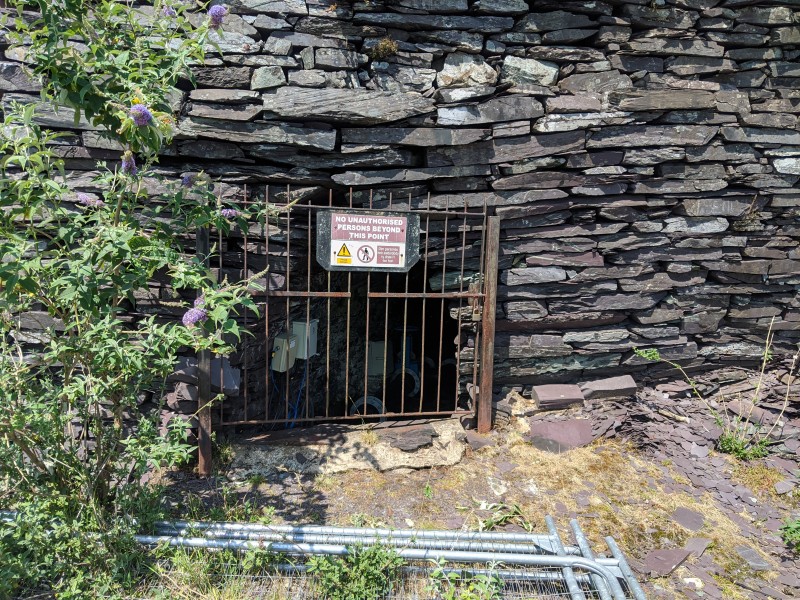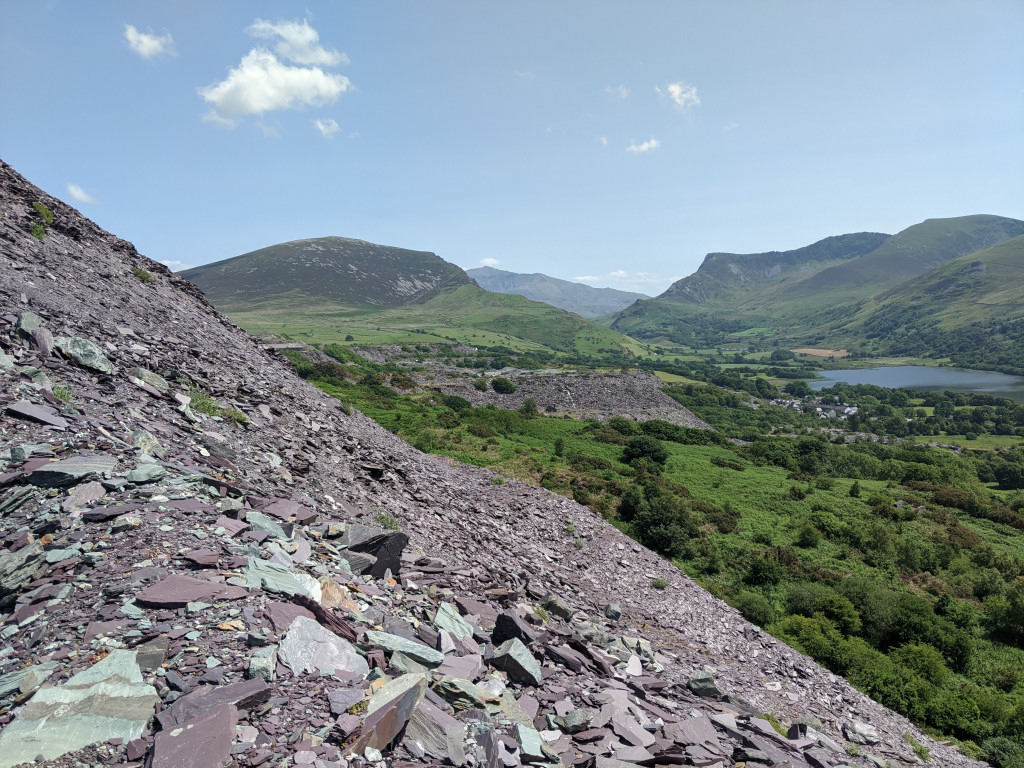



4 pits with tunnels. Some pits filled with landfill. Prominent S shaped traway (“Horseshoe” or “Ceserea Serpent”) leads toward tipping area and Bryngwyn Incline.
All buildings have been demolished, and the pits were used as a waste dump by the local council until landfill activity ceased in January 2009. Some tramway formations and inclines remain traceable across the site. The large spoil tip at the western end, along with the “Horseshoe” line and its associated tip at Bryn Hyfryd Terrace to the north, form prominent landscape features. The reservoir that once served the quarry is now partly dried out. The three main pits—Gloddfa Glitiau, Old Cilgwyn, and Veingoch—originally had mills standing on top of significant waste tips to the south and east.
Cilgwyn brought together numerous individual workings, some with origins stretching back to at least the thirteenth century, when the Cilgwyn & Cefn Du Company consolidated them in the early nineteenth century. By the 1840s the quarry had fallen largely idle and was frequently worked illicitly by trespassers. Operations resumed in the 1850s and quickly expanded into a major enterprise with four pits. By 1882, three hundred men were employed, producing 7,430 tons of slate annually.
Two separate steam-powered railway systems served the quarry: one operated within the workings, including tunnels connecting the pits, while a second ran around the southern and eastern rims of the excavations. Steam engines powered the main eastern mill and three southern mills, as well as chain inclines and Blondins. In the early 1900s, Cilgwyn became one of the first quarries in the area to adopt oil-engine–generated electricity.
Limited space for waste disposal downhill led to construction of a long spoil bank to the west; later tipping shifted north, served by a winding locomotive line. Before the Nantlle Railway existed, finished slate was shipped via Foryd and trans-shipped at Caernarfon. The quarry eventually gained access to the Nantlle Railway through an incline via Tal y Sarn quarry, later extended to connect with the Robinson Tramway serving Y Fron quarries. In 1881, with tipping encroaching and the tramway made redundant by alternative rail access from Y Fron, a new incline was built two hundred yards to the east. This was abandoned in 1923 when Cilgwyn secured direct access to the North Wales Narrow Gauge Railway via the “horseshoe” tipping line.
External Links
Publications (6)
- Gwyn, David, (2015); Welsh Slate: archaeology and history of an industry; Royal Commission on the Ancient and Historical Monuments of Wales; 9781871184518
- le Neve Foster, C. (1896); Mines & Quarries Report-North Wales; 57 pages
- Lindsay, Jean (1974); History of the North Wales Slate Industry; David & Charles; pp.314; ISBN 0-71536-264-X
- Richards, Alun J. (2013); Slate Quarrying in Wales; Gwasg Carreg Gwalch; ISBN 1-84527-026-6
- Richards, Alun John (1991); Gazeteer of the Welsh Slate Industry, A; Gwasg Carreg Gwalch 978-0863811968
- Richards, Alun John, (1999); The Slate Regions of North and Mid Wales and their Railways; Gwasg Carreg Gwalch; 0863815656