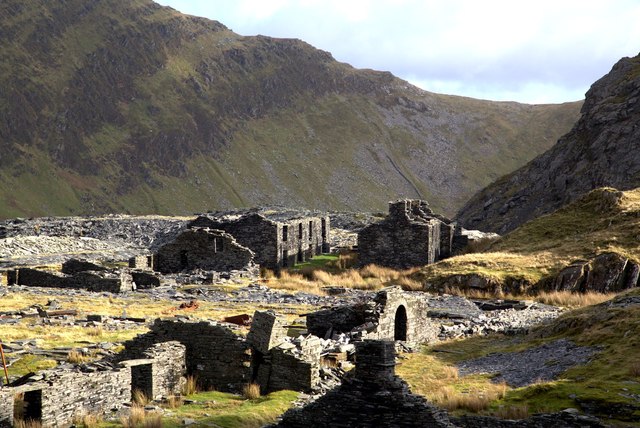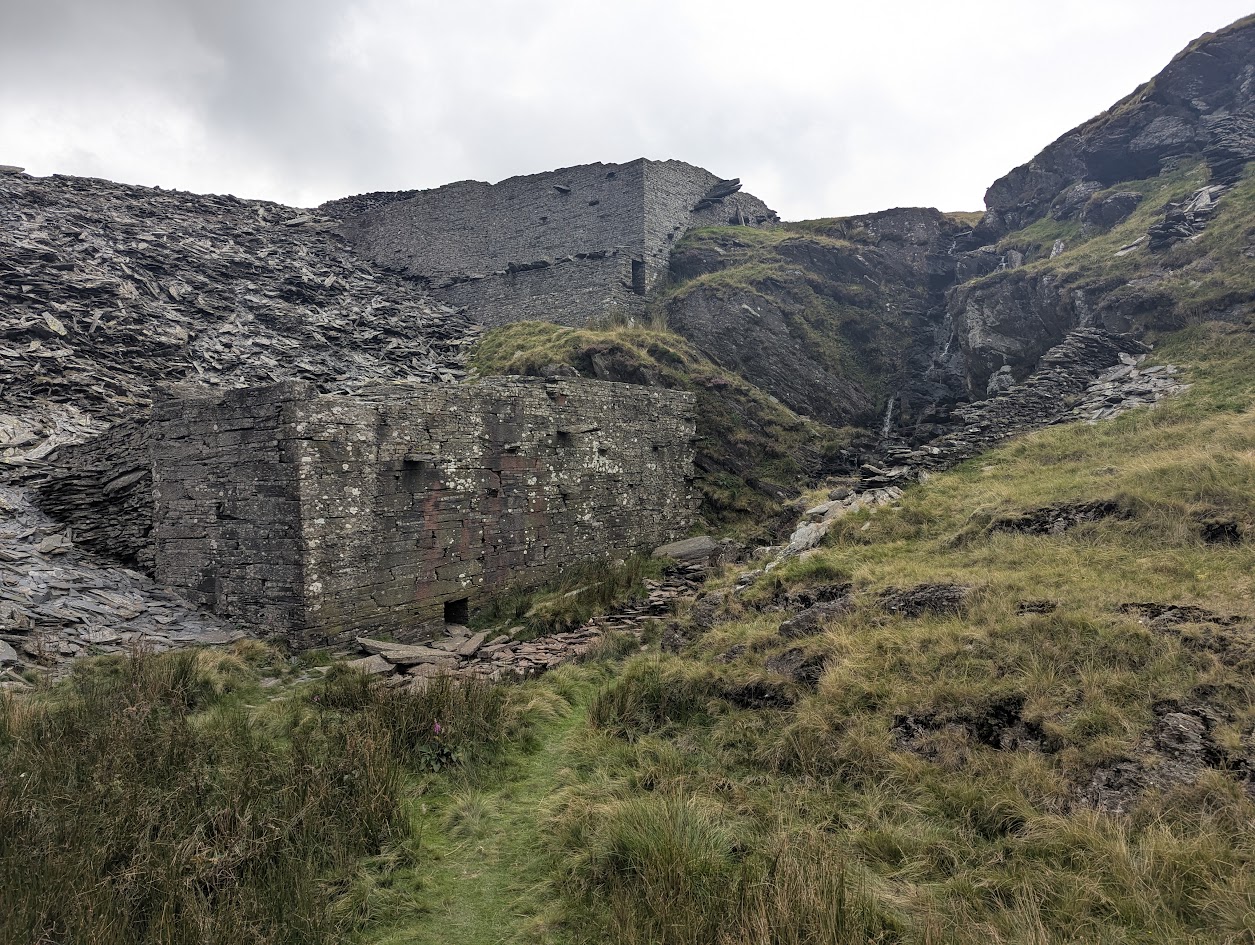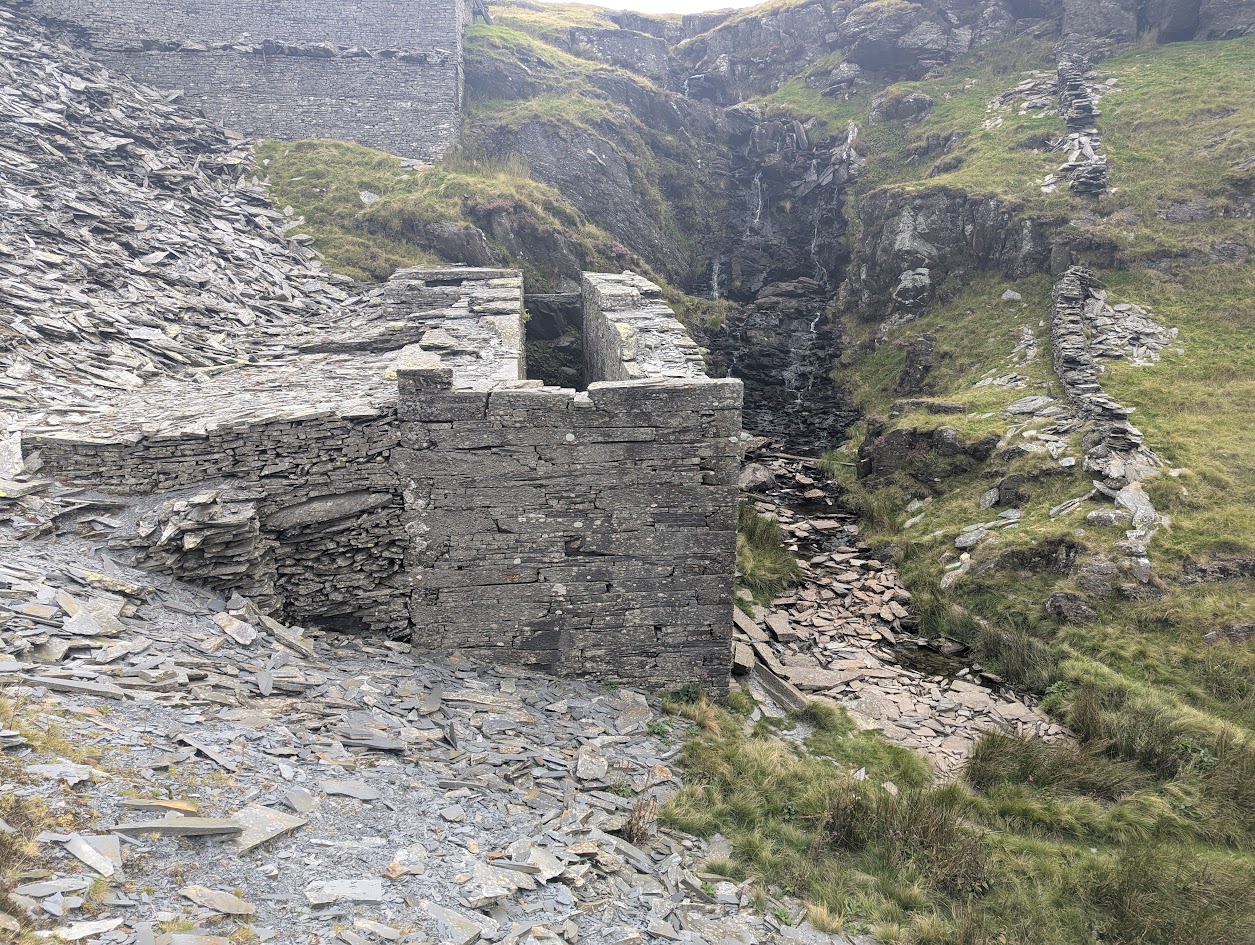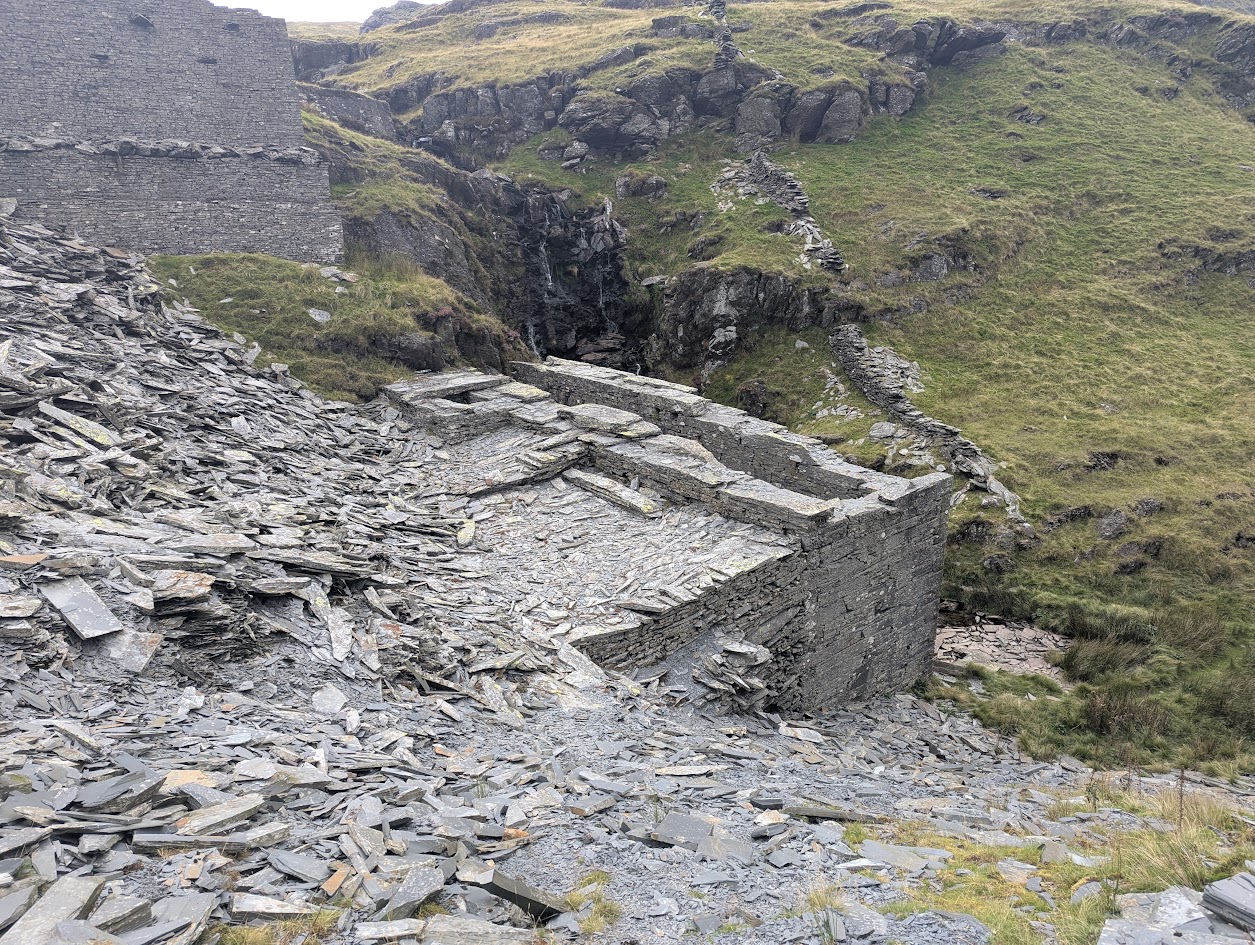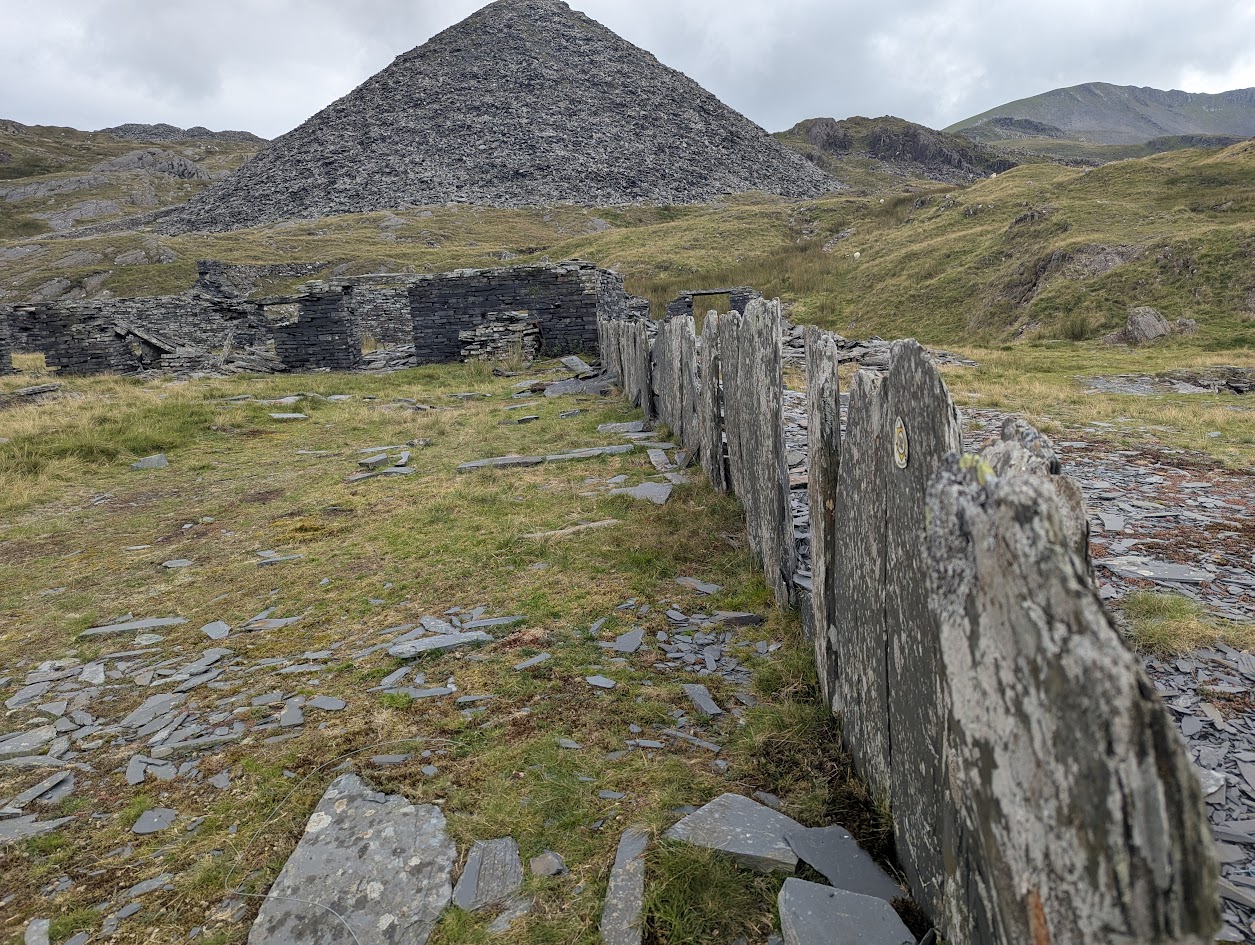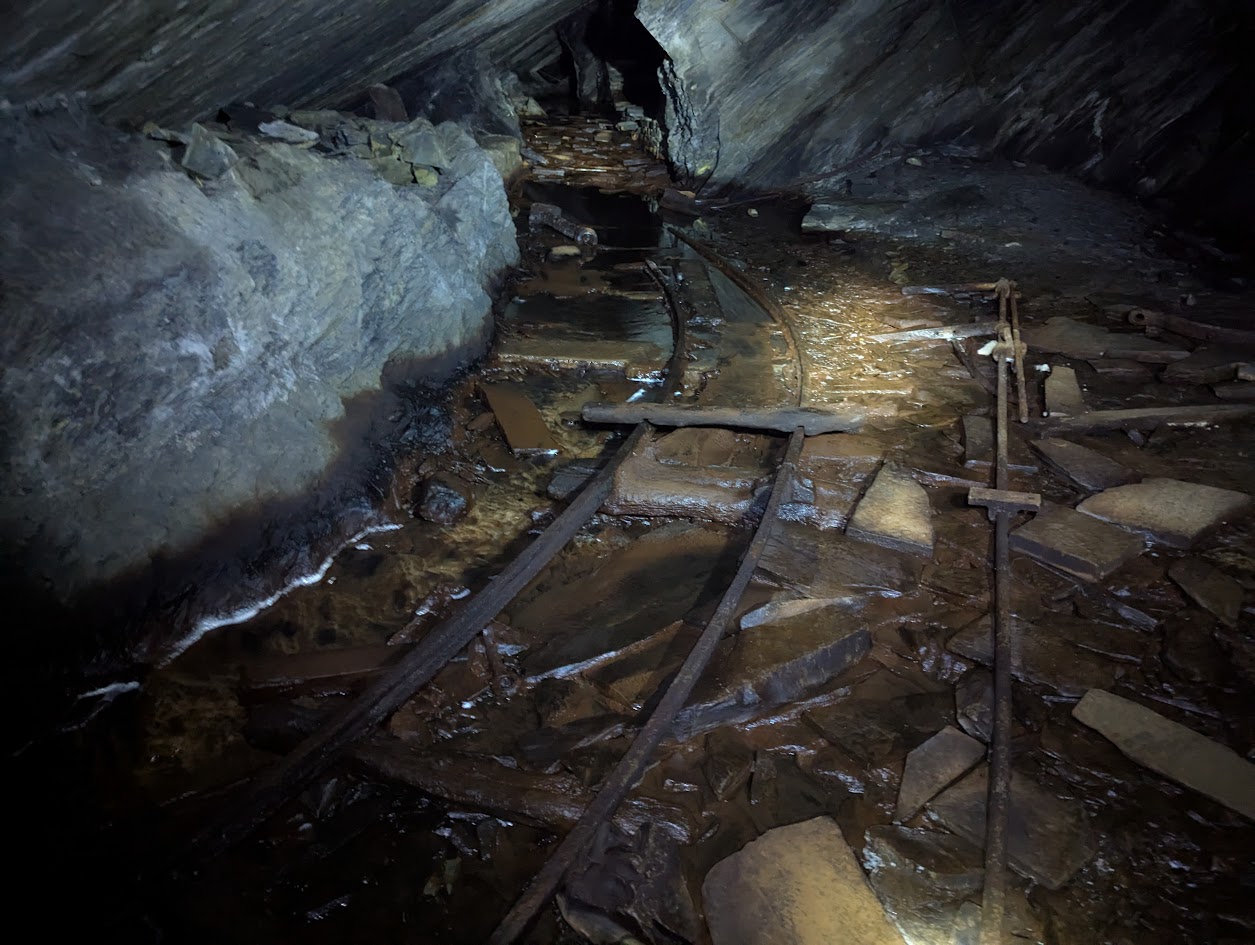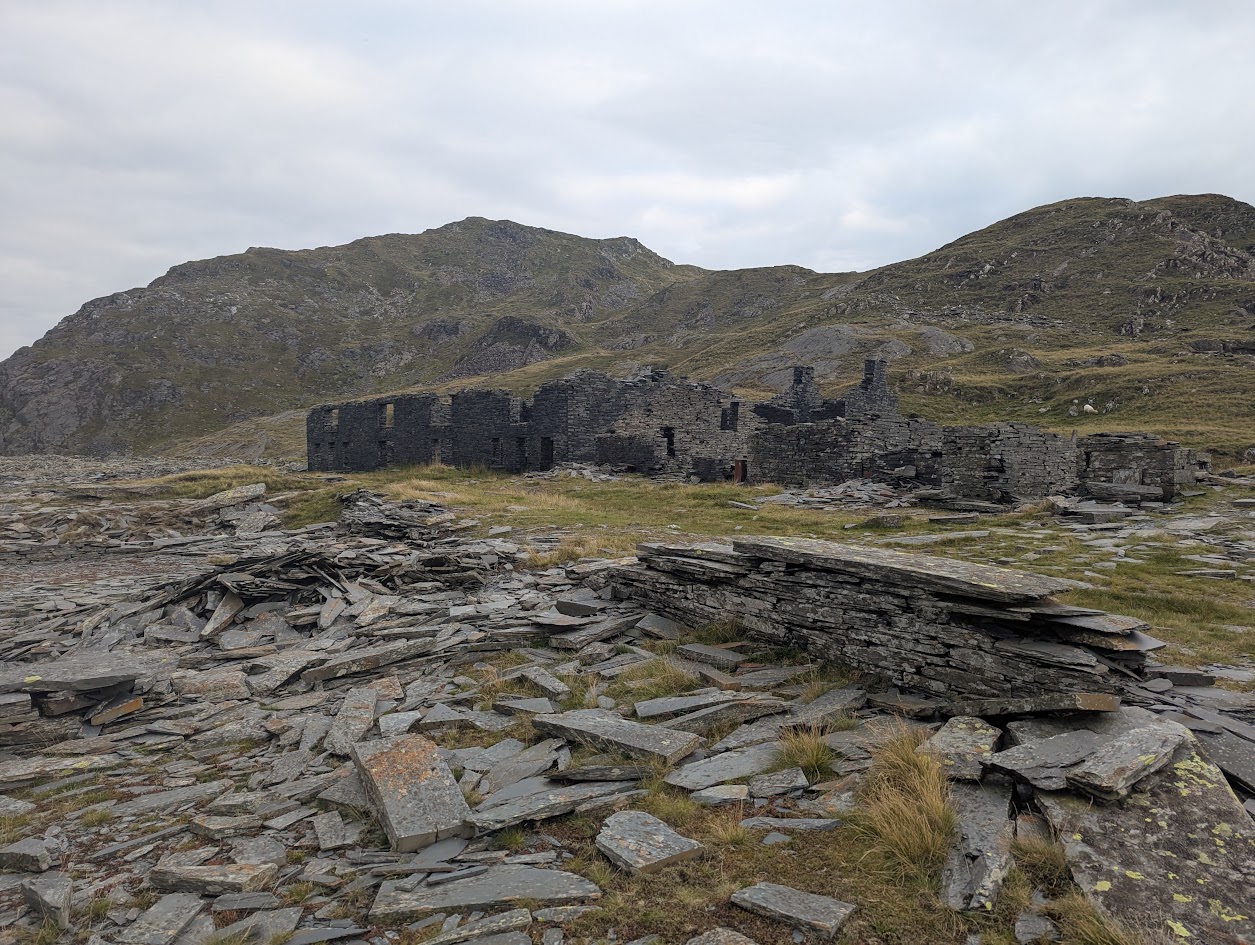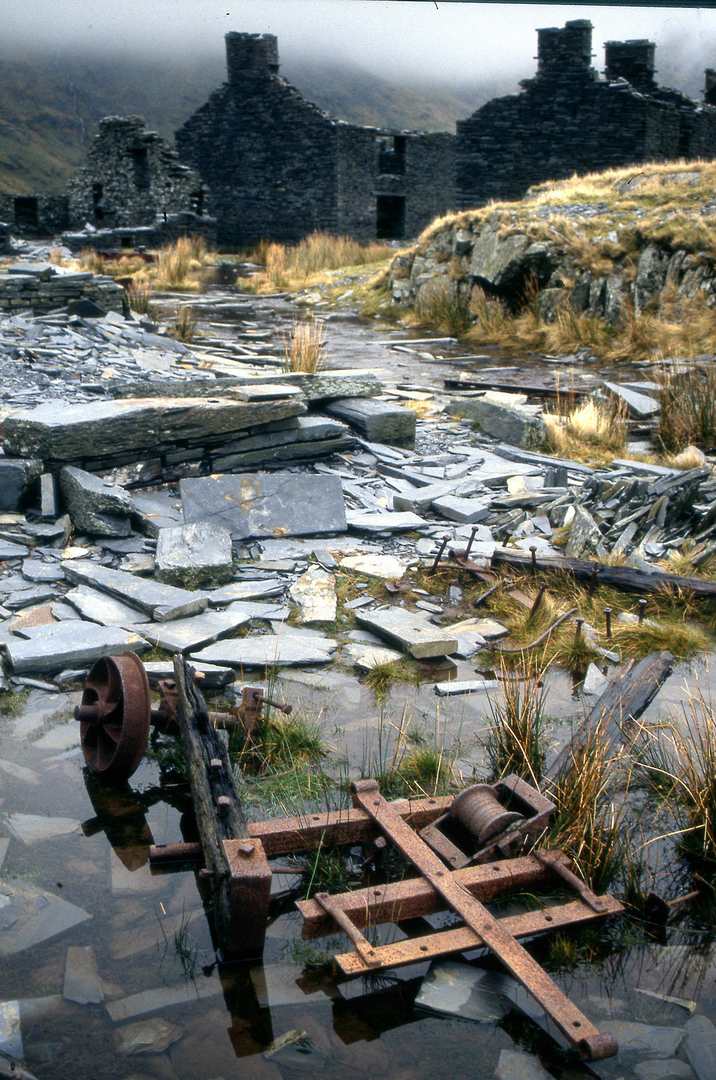



Largest underground quarry outside of Ffestiniog. Workings in 170 chambers on 14 levels, those below 9 now flooded. Long adit leads to chambering which apart for a couple of trial chambers are confined to one vein. An incline leads from the end of the adit to the surface at the West Twll where slate extraction originally commenced. During 1900, the eastern part of the workings collapsed underneath the area of the East Twll and the chambers are loose. The working to the west which are entered from the West Twll are safer and lead to the link passage with Croesor Mine. There are another couple of adits and shafts. The collapsed East Twll has quite a few deep looking crevices amongst the confusion. ***
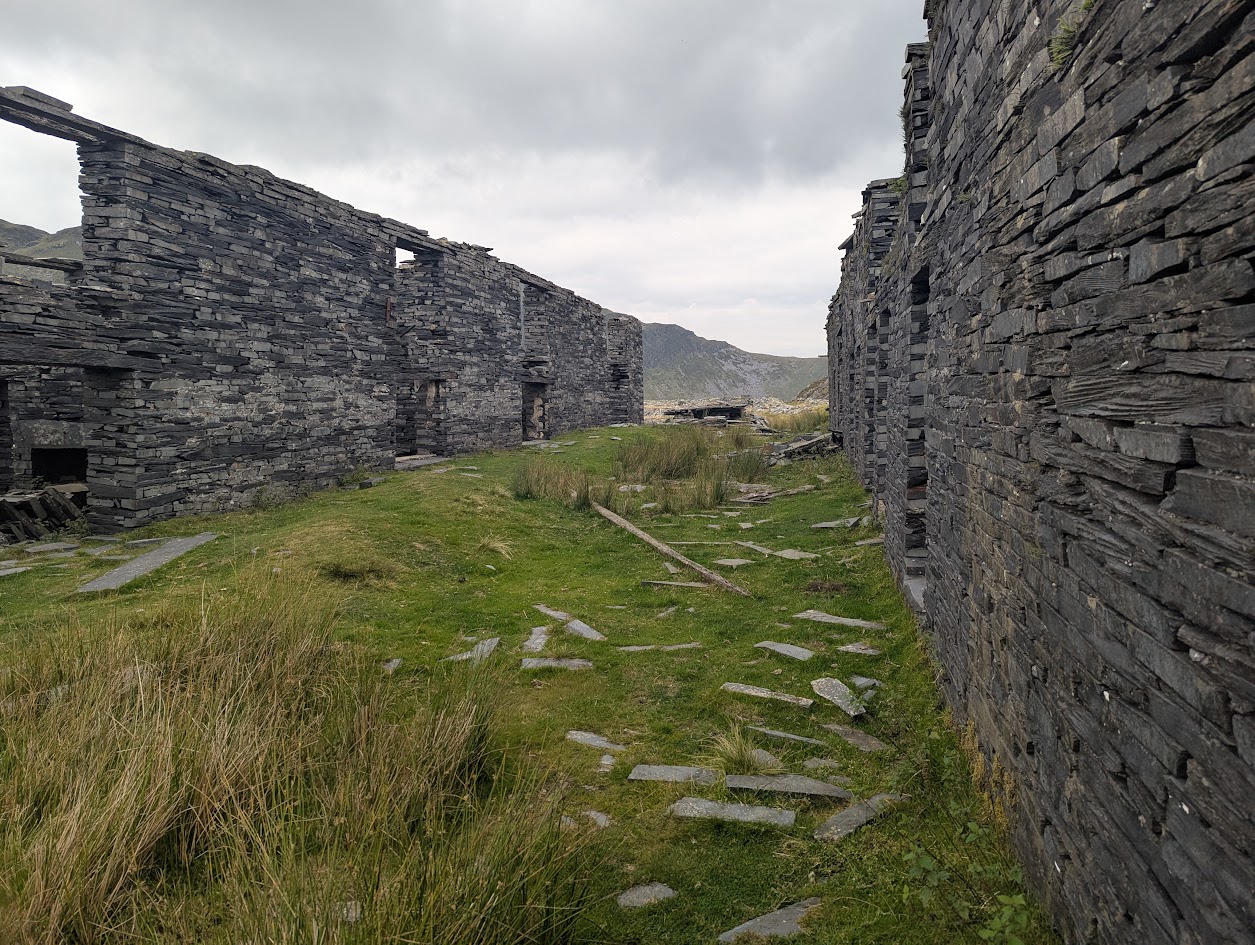
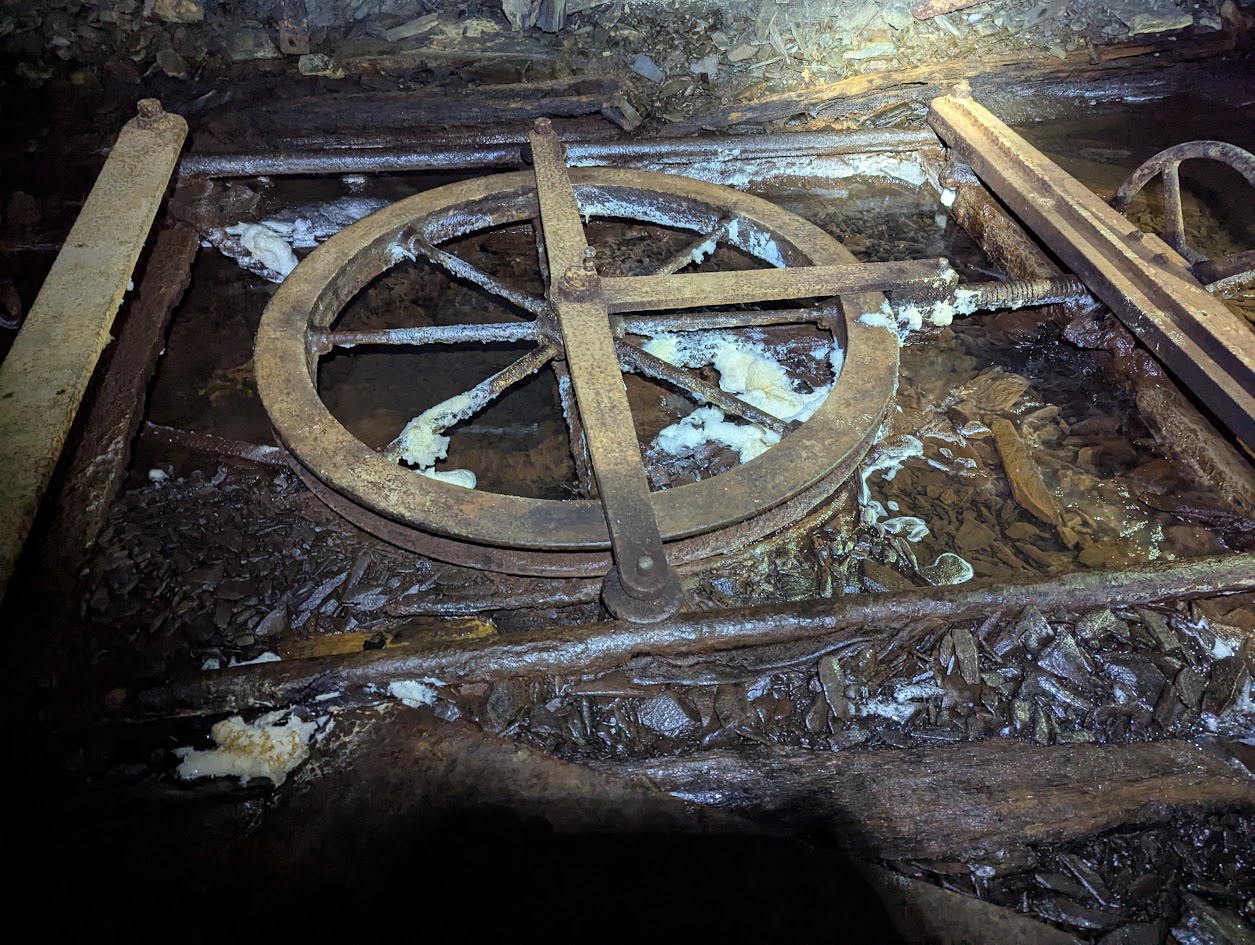
Buildings such as dressing sheds and workshops are arranged in chronological order northwards from the southern pits. While the main mill at Floor 9 has mostly vanished, remnants of infrastructure like tailrace culverts, haulage wheel pits, and gripper trucks persist. The workers’ barracks form a notable ‘street,’ and several inclines and machinery survive, though some have been removed for preservation. The adjoining tracks to Cwmorthin and the well-engineered tramway to Cwm Croesor, including the highest single-pitch incline in the slate industry, remain evident. Other surviving features include reservoirs, leat systems, a collapsed timber dam, and traces of old transport routes like the packhorse track over Moelwyn.
Within the underground network, features such as the Level 2 and Level 3 adits contain historic mills, workshops, and pump mechanisms. Inclines connect the various floors, forming an intricate haulage system powered by water and later Pelton wheels. The layout of chambers, shafts, and adits illustrates the substantial scale and complexity of the quarry’s operations. Additionally, the site’s social history is marked by the remains of worker housing, a chapel, and the manager’s residence, Plas Cwmorthin.
Rhosydd quarry opened in the 1830s, with initial underground developments commencing in the 1850s. Its extensive surface works, mills, and dressing sheds were constructed along the northward slope down to Floor 9, which served as the primary access and drainage level via a half-mile-long tunnel. Floor 9 was the hub of major surface infrastructure including the main mill and workers’ barracks. The quarry comprised five levels above Floor 9—with Floors 1 to 3 representing early open workings—and five floors below it. With around 70 chambers, Rhosydd ranked among the largest underground slate quarries outside Blaenau.
By 1883, the quarry employed 192 men and produced 5,616 tons of finished slate. The site utilized 24 saw tables and 24 dressing machines, with the first saws installed in 1854. Waterpower was extensively harnessed for multiple purposes such as pumping, hauling, electricity generation, air compression, and powering the mills. Due to a poor natural water catchment, complex leat systems, reservoirs, and even water-storing chambers were built.
The quarry’s inclines above Floor 9 were single-acting and counterbalanced by weighted trolleys on tracks positioned between rails. Vertical head-sheaves enabled two trucks to travel simultaneously through the narrow tunnels. Below Floor 9, initial haulage employed a water balance running in an inclined shaft connected via ropes and pulleys. Later, the lower incline was widened for triple-track operations powered by Pelton wheels. Although some stationary steam engines were used, no locos operated at Rhosydd.
A considerable community of workers and families lived on or near the quarry site, complete with their own chapel. Early transportation relied on packhorses passing over Moelwyn Mountain, later evolving to carts or sledges through the Cwm Orthin valley. After 1864, a highly engineered tramway linked Rhosydd to Cwm Croesor and ultimately to the Croesor Tramway for slate transport. Finally closed in 1930.
External Links
Publications (43)
- (1982); CATMHS - Newsletter 001; 27 pages
- (1983); CATMHS - Newsletter 003-December; 34 pages
- (1988); WMS Newsletter Issue 18 May; 12 pages
- (1991); CATMHS - Newsletter 030-July; 20 pages
- (1991); WMS Newsletter Issue 24 Jun; 4 pages
- (1993); CATMHS - Newsletter 035-July; 33 pages
- (1993); WMS Newsletter Issue 29 Dec; 8 pages
- (1994); CATMHS - Newsletter 037-January; 29 pages
- (1994); CATMHS - Newsletter 038-April; 40 pages
- (1994); CATMHS - Newsletter 039-July; 37 pages
- (1994); CATMHS - Newsletter 040-October; 31 pages
- (1994); Ogofa GCPC Journal No 3, Autumn; 39 pages
- (1994); WMS Newsletter Issue 31 Dec; 10 pages
- (1995); WMS Newsletter Issue 32 Jun; 7 pages
- (1996); WMS Newsletter Issue 34 Jun; 7 pages
- (1997); CATMHS - Newsletter 049-March; 26 pages
- (1997); CATMHS - Newsletter 051-October; 20 pages
- (1997); WMS Newsletter Issue 36 Jun; 8 pages
- (1997); WMS Newsletter Issue 37 Dec; 11 pages
- (1998); CATMHS - Newsletter 053-April; 27 pages
- (1998); CATMHS - Newsletter 054-August; 30 pages
- (1998); CATMHS - Newsletter 055-November; 29 pages
- (1998); WMS Newsletter Issue 39 Dec; 8 pages
- (1999); CATMHS - Newsletter 056-February; 28 pages
- (1999); WMS Newsletter Issue 41 Nov; 16 pages
- (2000); CATMHS - Newsletter 061-September; 38 pages
- (2002); WMS Newsletter Issue 47 Oct; 28 pages
- (2005); CATMHS - Newsletter 081-November; 29 pages
- (2006); CATMHS - Newsletter 085-November; 22 pages
- (2007); CATMHS - Newsletter 086-February; 43 pages
- (2020); WMS Newsletter Issue 83 Autumn; 36 pages
- Gwyn, David, (2015); Welsh Slate: archaeology and history of an industry; Royal Commission on the Ancient and Historical Monuments of Wales; 9781871184518
- Jarratt, Tony (1974); Logbook 1; 105 pages
- Lewis M.J.T. & Denton J.H. (1994); Rhosydd Slate Quarry.
- Lindsay, Jean (1974); History of the North Wales Slate Industry; David & Charles; pp.331; ISBN 0-71536-264-X
- NMRS; Newsletter Aug/1994; p.5
- NMRS; Newsletter Aug/1995; p.11
- NMRS; Newsletter May/1989; p.1
- NMRS; Newsletter May/1994; p.5
- Richards, Alun J. (2013); Slate Quarrying in Wales; Gwasg Carreg Gwalch; ISBN 1-84527-026-6
- Richards, Alun John (1991); Gazeteer of the Welsh Slate Industry, A; Gwasg Carreg Gwalch 978-0863811968
- Richards, Alun John, (1999); The Slate Regions of North and Mid Wales and their Railways; Gwasg Carreg Gwalch; 0863815995
- Richards, Alun John, (2002); Fragments of Mine & Mill in Wales; pp.50, 93 ; Gwasg Carreg Gwalch; 0863818129