



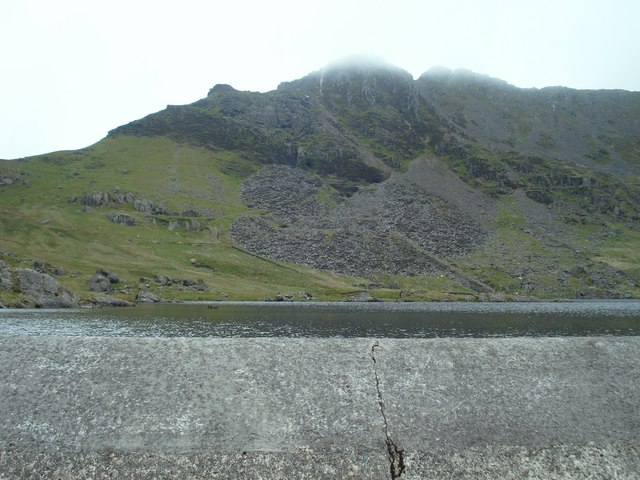
At the original southern workings, several adits, now gridded, survive along with fragmentary building remains from the 1860s phase. The upper two pitches of the incline were partly removed when Llyn Stwlan was enlarged in 1960 for the pumped-storage scheme. This same project destroyed most of the mill site, although minor traces can still be identified. The four lower incline pitches, running past the modern generating station to the former line of the Ffestiniog Railway, survive.
Generally unsuccessful quarry, first opened in the early 1800s as a set of small levels on the east flank of Moelwyn Bach around 1700 ft above sea level. After unsuccessful trials in the 1820s, it was significantly redeveloped during the 1860s as an underground working on the south-eastern slopes of Moelwyn Mawr. A large mill was built at SH668444, equipped with six saw benches and seven dressing machines, all driven by a 40 ft × 4 ft waterwheel supplied from Llyn Stwlan. On-site were barracks and family dwellings; children reportedly walked to school in Tanygrisiau. The quarry worked intermittently: active in the 1870s, again in the 1890s, and finally closed around 1900, with its workings subsequently absorbed into Pant Mawr.
Early output was transported by packhorse down Cwm Maesgwm via a track constructed in 1826. From about 1860, material was dispatched using the Ffestiniog Railway, reached by the quarry’s dramatic incline system.
At altitude of 1700’ above the Stwlan reservoir on Moelwyn Mawr. Number of adits with dangerous internal shafts (fatalities during mid 1990’s). Adits currently gated.**
External Links
Publications (7)
- (1994); CATMHS - Newsletter 038-April; 40 pages
- Anon; Buarth Melyn and Moelwyn Slate Quarry; 1 pages
- Gwyn, David, (2015); Welsh Slate: archaeology and history of an industry; Royal Commission on the Ancient and Historical Monuments of Wales; 9781871184518
- Lindsay, Jean (1974); History of the North Wales Slate Industry; David & Charles; pp.326; ISBN 0-71536-264-X
- Richards, Alun J. (2013); Slate Quarrying in Wales; Gwasg Carreg Gwalch; ISBN 1-84527-026-6
- Richards, Alun John (1991); Gazeteer of the Welsh Slate Industry, A; Gwasg Carreg Gwalch 978-0863811968
- Richards, Alun John, (1999); The Slate Regions of North and Mid Wales and their Railways; Gwasg Carreg Gwalch; 0863815898


