



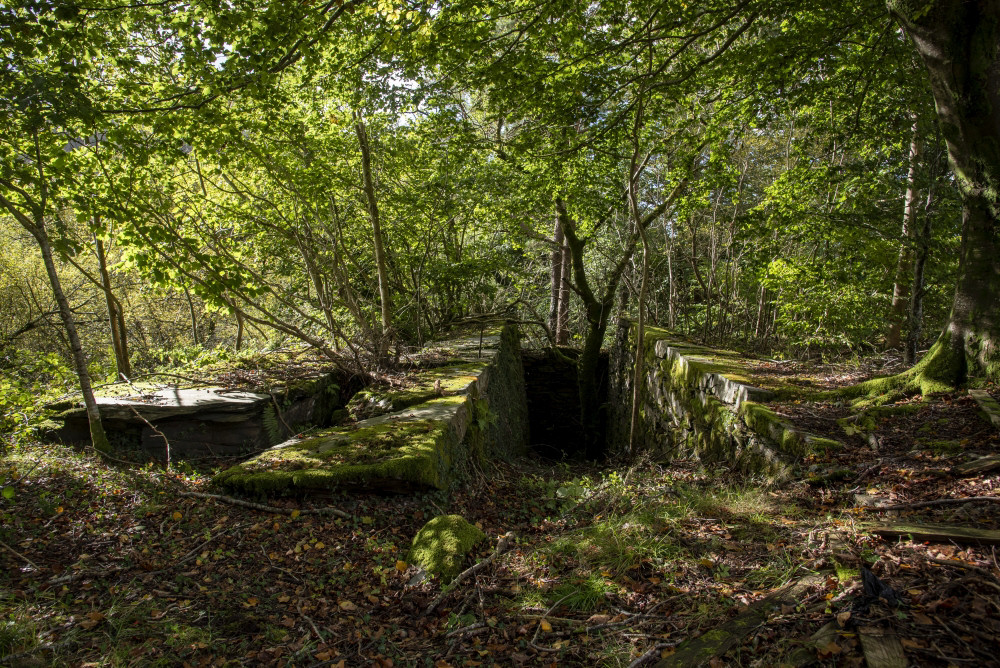
Open pit slab workings.*
The main pit now lies flooded. The original mill site presents considerable interpretive challenges, having been bisected by the Llanfrothen road. Fragmentary remains of the mill’s end walls survive on one side of the road, while on the other stands the wheel pit for what was reputedly the largest waterwheel in Wales. The former wooden launder that once channelled water from the pond, now converted to a children’s pool, has completely disappeared.
A short incline ran down to the mill and appears to have conveyed finished product back up to the Croesor Tramway, likely powered by the mill wheel. Although an injector pump was introduced at a later stage, the exceptional scale of the wheel suggests it also performed pumping duties. Nearby lies a tiny structure with a small wheel pit, possibly the site of a small compressor house. The cutting for the tramway connection survives clearly.
Operating as an open pit working in close association with the Parc quarry, this operation became established as a significant slate production site. By 1870, the workforce had grown to around 20 men, nearly all of whom were engaged in slab production. The finished slate was dispatched efficiently via a short branch line that connected to the Croesor Tramway at Croesor village.
Publications (2)
- Richards, Alun J. (2013); Slate Quarrying in Wales; Gwasg Carreg Gwalch; ISBN 1-84527-026-6
- Richards, Alun John (1991); Gazeteer of the Welsh Slate Industry, A; Gwasg Carreg Gwalch 978-0863811968


