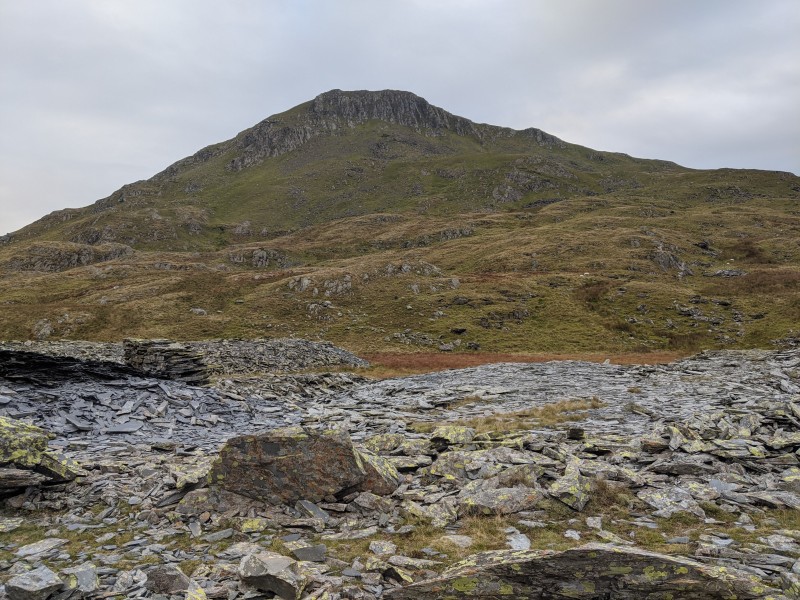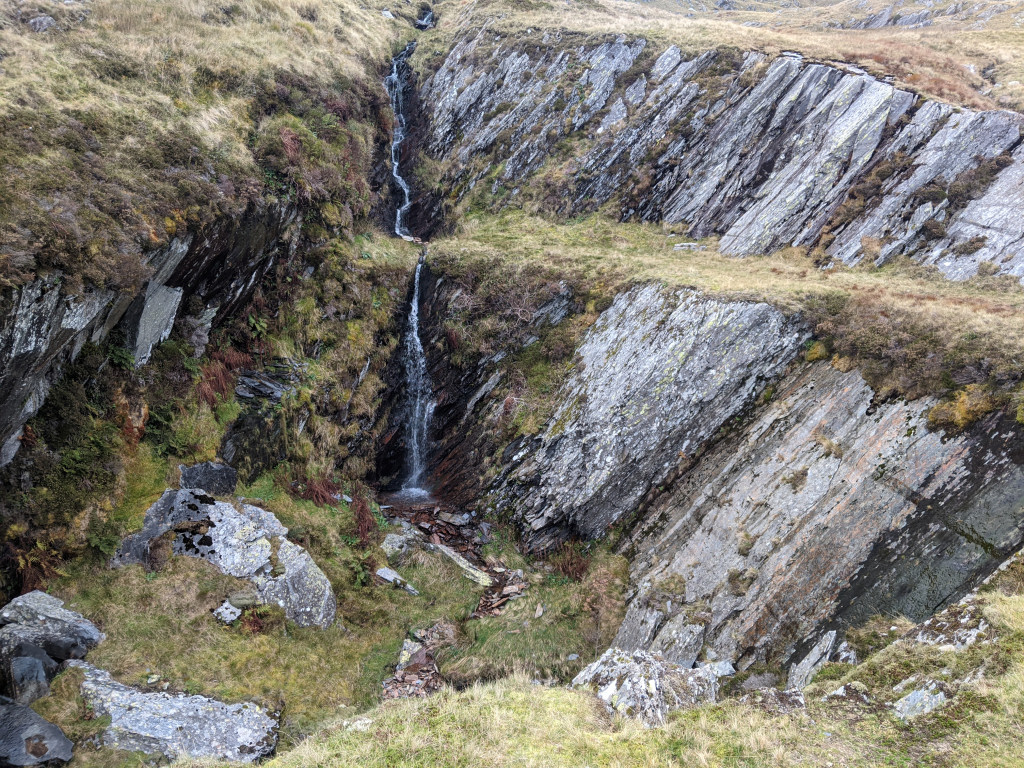



Open pits.
Two small reservoirs sit at the top of the site, with a holding pond below, a reminder of the challenge of collecting enough water so close to the summit. Above the upper pits lie trial workings and a short tunnel, while just below are the remains of the upper mill, including a well-built launder wall that once carried water to the wheel. Further down the hillside are traces of another mill, probably moved to avoid hauling stone uphill and perhaps to make use of a later tunnel into the deeper workings. The incline system survives in parts: the upper incline has a set-back sheave pit, while the lower drum house unusually carried horizontal overhead sheaves, rare in Caernarfonshire. Scattered remains include a weighbridge platform, a third mill site, a wheel pit, and the rusting frame of a rubbish wagon said to have been riddled with holes during American troop exercises in 1944. In the lower area stands a barracks-type building, with hints of a former stable. A little way from the main workings are small exploratory pits and the collapsed entrance to a trial level; debris here shows that rubbish wagons once ran directly on slate-surfaced tracks, suggesting that the quarry’s final years were decidedly low-budget. The access road crosses a fine slate-slab bridge, later reinforced with T-bulb and round-bar rail, with bullhead rail found nearby, small reminders of the site’s varied and improvised transport history.
Bwlch Cwmllan was worked in two main periods, with the earliest activity likely beginning in the 1840s, when stone from the upper pits was taken by tunnel to a small water-powered mill. A renewed push in the mid-1870s brought a fresh set of workings higher up the slope, accompanied by a new mill and what appears to have been a two-stage chain incline to move material downhill. Later alterations added a third mill and new access routes, probably to reduce the effort of hauling stone out of deepening pits. Despite these investments, production remained modest at around eight hundred and fifty tons in 1877, largely slab, and never justified the heavy overburden removal or the intended link to the Rhyd Ddu NWNGR station, whose planned inclines were never completed.
Publications (4)
- Gwyn, David, (2015); Welsh Slate: archaeology and history of an industry; Royal Commission on the Ancient and Historical Monuments of Wales; 9781871184518
- Jones, Gwynfor P., Richards, Alun J. (2004); Cwm Gwyrfai; pp.82-99; Gwasg Carreg Gwalch ISBN 0-86381-897-8
- Richards, Alun John (1991); Gazeteer of the Welsh Slate Industry, A; Gwasg Carreg Gwalch 978-0863811968
- Richards, Alun John, (1999); The Slate Regions of North and Mid Wales and their Railways; Gwasg Carreg Gwalch; 0863815602