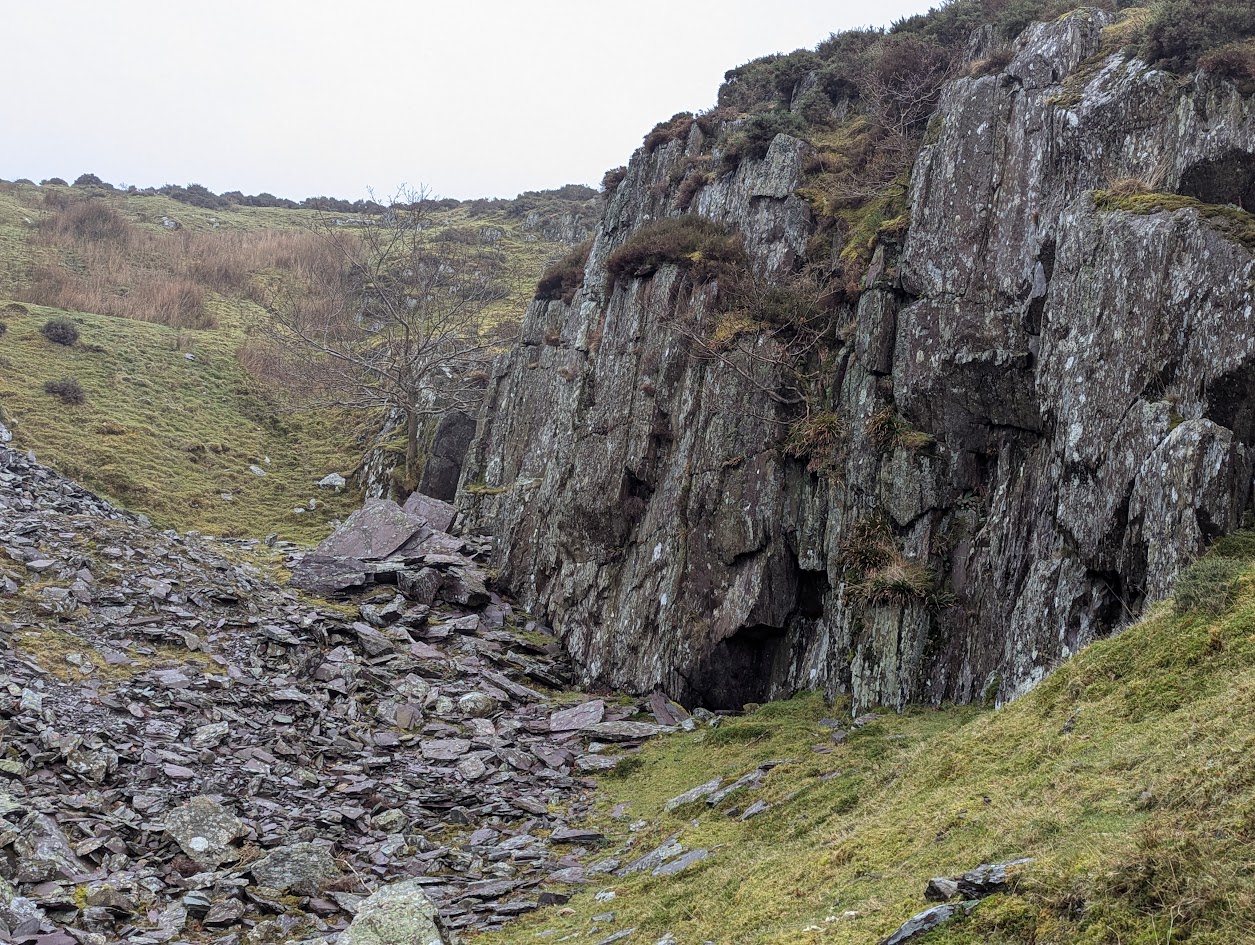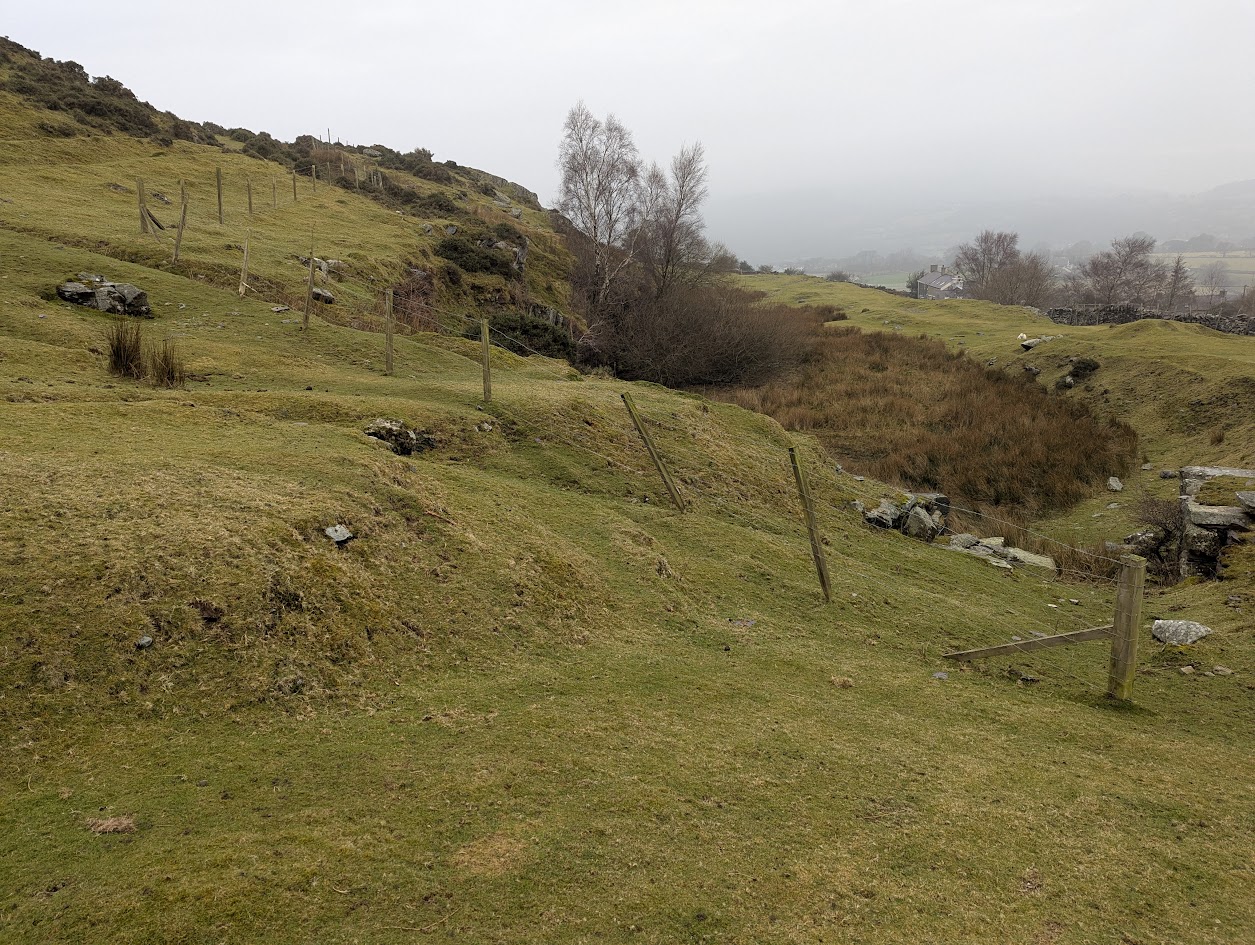



Remains of adits, pits and inclines.*
Several adits still survive, two of which remain safely enterable for short stretches, along with fragmentary traces of the original buildings. The most striking feature is the grass‑covered upper incline formation, while the course of the tramway to Tan‑y‑Bwlch can still be followed across the landscape. A nearby row of quarry cottages is reported to be in good condition, but the lower incline and the mill site have effectively disappeared,
Small underground quarry established in the mid-19th century, specializing in the production of red slate. The workings consisted of three adit levels interconnected by an incline, with only limited chambering. While the rock quality was considered good, the slate’s color was noted to change from red to green as the depth of the workings increased. Following the major Penrhyn strike of 1900–1903, the quarry was run as a co-operative. Early output was transported by a second incline and then carted via Rachub. Later, the quarry was connected by a tramway to the Tan-y-Bwlch mill. It ultimately ceased operations around 1910.
Publications (5)
- Gwyn, David, (2015); Welsh Slate: archaeology and history of an industry; Royal Commission on the Ancient and Historical Monuments of Wales; 9781871184518
- Lindsay, Jean (1974); History of the North Wales Slate Industry; David & Charles; pp.325; ISBN 0-71536-264-X
- Richards, Alun J. (2013); Slate Quarrying in Wales; Gwasg Carreg Gwalch; ISBN 1-84527-026-6
- Richards, Alun John (1991); Gazeteer of the Welsh Slate Industry, A; Gwasg Carreg Gwalch 978-0863811968
- Richards, Alun John, (1999); The Slate Regions of North and Mid Wales and their Railways; Gwasg Carreg Gwalch; 0863815890