



Underground, 3 adits to chambers. Tunnel to Cwm Croesor.**
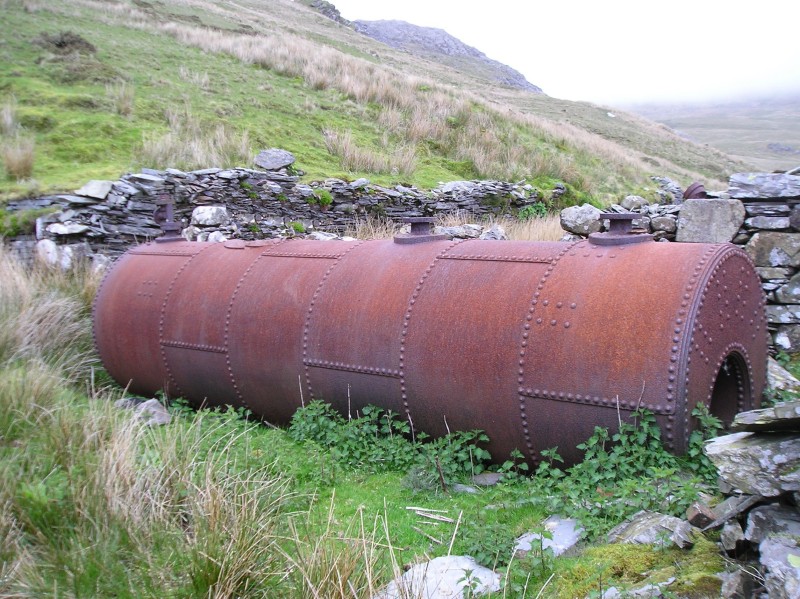
The upper mill, known as Level 18, contained evidence of three saw tables and three dressing machines, although the building was large enough to accommodate twice that number. A large Lancashire boiler remains beside the mill, possibly repurposed from Pant Mawr and used for water storage. The single-acting table incline served as a water balance, with a slate-lined water channel running alongside it. Multiple adits survive, some blocked and others wet, leading to chambers carved into poor-quality rock. Much backfilling, including inside the adits, is evident.
Along the tramway, foundations of an elevated office stand midway, while the drumhouse and incline to the lower mill remain in good condition. The lower mill building, however, is in a very ruinous state. The tunnel used to transport slate is one of the longest horse-drawn tunnels outside a quarry and remains passable until a collapse near its northern end. Internal chambering exists within the tunnel. The tramway that crosses the hill to the Croesor Valley is still traceable today, and brake gear along with rope rollers survives near the incline.
Froenboeth was established as an underground extension of the Pant Mawr quarry workings, commencing operations in 1886. At its peak in the early 1900s, the quarry employed up to 50 men, although it never achieved commercial success. Access to the quarry chambers was provided by three adits. A short, single-acting table incline was used to lower extracted material to a steam-powered mill. From there, the finished slate was transported along a tramway that followed the land’s contour to the top of a stone-embanked incline. A 500-yard tunnel then carried the slate from the foot of the incline to Cwm Croesor. From Cwm Croesor, the route ascended to the head of the lower Pant Mawr incline, while the upper pitch was abandoned.
In the early 1890s, a second mill was constructed at the tunnel entrance to process material from Cefn y Braich and rock brought from the tunnel. This facility was designated Level 22 in the extended floor numbering system of the Pant Mawr/Moelwyn operations.
External Links
Publications (5)
- (1997); WMS Newsletter Issue 36 Jun; 8 pages
- Richards, Alun J. (2013); Slate Quarrying in Wales; Gwasg Carreg Gwalch; ISBN 1-84527-026-6
- Richards, Alun John (1991); Gazeteer of the Welsh Slate Industry, A; Gwasg Carreg Gwalch 978-0863811968
- Richards, Alun John, (1999); The Slate Regions of North and Mid Wales and their Railways; Gwasg Carreg Gwalch; 0863815787
- Richards, Alun John, (2002); Fragments of Mine & Mill in Wales; p.83 ; Gwasg Carreg Gwalch; 0863818129


